Corporate Gift Planning for Christmas 2025: A Cost Controller's Checklist for Anthropologie-Style Gifts
-
Step 1: Set the design benchmark before you set the price range
-
Step 2: Build a gift matrix and keep the product mix small
-
Step 3: Get transparent per-unit costs — not just a price
-
Step 4: Factor in packaging, freight, and fulfillment
-
Step 5: Ask the longevity questions that change perceived value
- Two mistakes I still see buyers make
It took me three years and about 90 orders to understand that “Anthropologie-style” is not a product category. It's a design benchmark. I'm a procurement manager at a 50-person marketing agency. I've managed our corporate gifting budget for six years, negotiated with 40+ vendors, and documented every order in our cost tracking system. So when my boss started planning client gifts for Christmas 2025 and sent me Anthropologie Christmas 2025 preview links, I knew the assignment: “Make it look like this, but keep it within budget.” I built a five-step checklist. If you're in charge of corporate gifting, this will save you the costly mistakes I've already made.
Let me be clear about what this checklist is for. It's for a team that wants the Anthropologie gift aesthetic — the handcrafted glass, the earth-toned scent, the kind of packaging people keep — without actually paying Anthropologie prices. This is not about copying anyone's designs. It's about specifying the same visual cues to suppliers who can hit them. And, basically, doing that in a way that won't blow up your Q4 budget.
Step 1: Set the design benchmark before you set the price range
I used to start with the budget and work backward. That's backwards.
For Christmas 2025, the Anthropologie aesthetic is trending toward what I'd call “quietly decorative”: matte ceramics, amber glass, sculptural forms, botanical prints. If you look at an Anthropologie wedding guest dress, you'll see the same design language that drives their home sections — soft structure, artful details, a vintage feeling that still reads modern. That consistency is the best clue for a gift buyer.
Write down the visual requirements before you look at unit prices: color palette, material, finish, height or size, packaging. “Like Anthropologie” is not a spec. “Amber glass candle with a matte cream label, 200g, gift box” is a spec. Once you have that, you can compare apples to apples.
Step 2: Build a gift matrix and keep the product mix small
In my cost tracking system, I have 61 gift projects over six years. The ones that went over budget almost always had the same cause: too many product lines. If you're sending gifts to 200 clients, you don't need 15 SKUs. You need three.
Here's a typical tier matrix:
- Premium clients: a glass figurine or sculptural ornament, plus a scented candle in a reusable glass vessel, with a custom packing insert.
- Core clients: a scented candle or a 100ml reed diffuser set in your branded color.
- Prospects and event attendees: a small glass ornament or a mini candle, under $15 per unit.
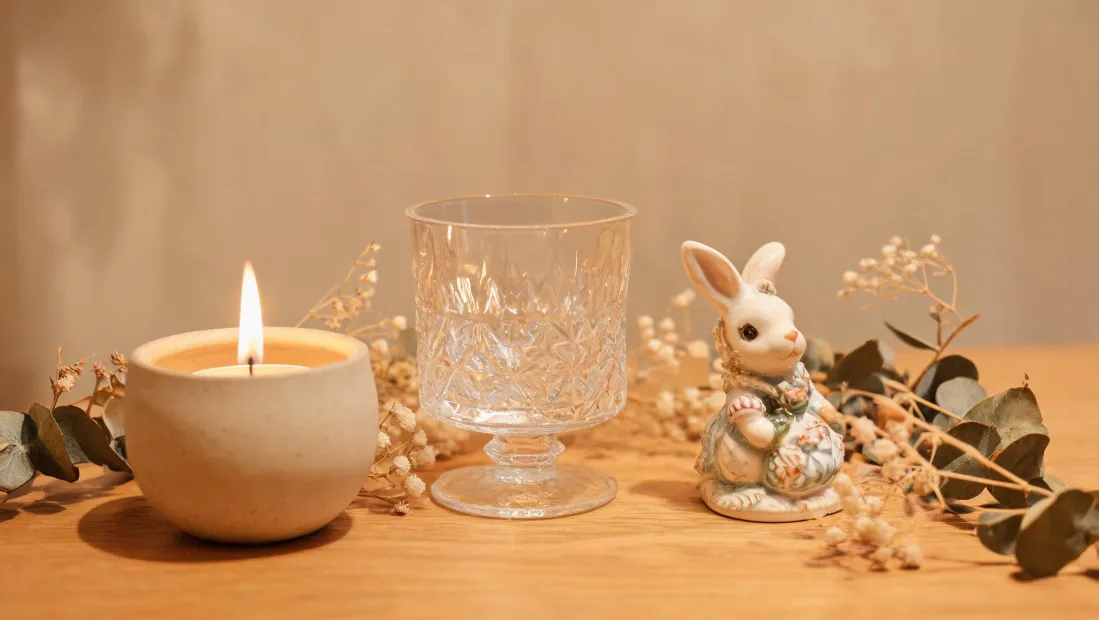
That's where the Anthropologie-inspired lineup gets practical. Instead of chasing every item in the catalog, you choose the pieces with the strongest visual family. A satin candle label, an amber vessel, and a hand-finished glass shape carry the aesthetic without needing a logo plastered on the front.
One note on glass figurines: when a supplier says “assorted glass figurine,” don't assume anything. I once approved a sample that was beautiful and 10cm tall. The production order arrived at 6cm. The dimensions were in the line item, but I hadn't verified them. Now I write a minimum size and base weight into every PO for decorated glass.
Step 3: Get transparent per-unit costs — not just a price
This is the step where I got burned.
We had a vendor quote a great price on branded candles. The unit price was $12.80. After setup, custom Pantone label, individual tissue wrap, and freight, the landed cost was $18.40. That's a 44% difference hidden in line items.
Now I ask the same five questions every time:
- What's not included in this unit price?
- Is there a setup fee for custom labels or embossing?
- Are there one-time die or mold fees for a glass figurine or ornament shape?
- What is the freight quote for our delivery ZIP — per box or per pallet?
- If pieces arrive damaged, how are replacements handled, and who pays return freight?
I only became this paranoid after ignoring a “free setup” promise. The vendor said no setup fee, then charged me a $45 pre-production proof fee and $60 to match a Pantone color. In my experience, the vendor who lists all fees upfront is usually the one who costs less in the end. Bottom line: if a supplier can't give you a full line-item quote, that's a red flag.
Step 4: Factor in packaging, freight, and fulfillment
Most buyers focus on per-unit pricing and completely miss shipping, packaging, and fulfillment. I'd argue that blind spot adds 30% to a lot of corporate gifting budgets.
When I audited our 2023 spending, 28% of our gifting budget went to shipping, packing materials, and fulfillment labor — not products. So when you're budgeting for Christmas 2025, make those line items visible from day one.
Plus, for an Anthropologie-style gift, packaging may matter more than the product. A $16 scented candle in a rigid gift box feels like a $35 gift. The same candle in a plain mailer feels like a sample. You don't need a bespoke luxury box; a simple printed outer carton with tissue and a thank-you card does the trick.
And here's a real comparison from my records: in Q2 2024, one vendor quoted $1,200 and then added $210 in freight and $95 in handling. Another quoted $1,380 with freight and gift boxing included. The second one was $115 cheaper in the end. That's the kind of math I'd rather do before signing, not after. Also, don't budget with old freight numbers. USPS rates changed in July 2024, and carriers have announced 2025 increases. Always get a quote to your actual delivery ZIP.
Step 5: Ask the longevity questions that change perceived value
The question I hear most often is, “How long does a 100ml reed diffuser last?” The more useful question is “How long should it last for the price we're paying?”
In my tests, a 100ml reed diffuser typically lasts around 8–10 weeks in an average office space of about 15 square metres, with the standard six to eight reeds. But that lifespan is not fixed. If the room is warm or dry, it might last 6 weeks. If it's a cool, quiet room and you never flip the reeds, it could run 12 weeks. That's the difference between a supplier's “estimates” and your clients' realities.
Now the insider part: people think a longer-lasting diffuser means a better diffuser. Actually, longevity and fragrance throw are trade-offs. A higher fragrance oil concentration will scent a room faster and more strongly, but it will also evaporate faster. A lighter formula may last two months but won't fill a larger office. Then again, longevity isn't the same as value. I'd rather buy a diffuser that smells great for 8 to 10 weeks than one that barely smells for 12.
For scented candles, don't rely on “about 40 hours” without proof. In our own burn tests on branded 8oz soy candles, we measured 46 to 54 hours, depending on wick and draft. Ask your supplier for their burn test data in writing. If they don't have it, that's a deal-breaker for me.
As of January 2025, my ballpark planning ranges from supplier quotes were $9–$15 for an 8oz branded scented candle at 300 units, and $8–$13 for a 100ml reed diffuser with six reeds. Use those as rough numbers, not as an official quote.
Two mistakes I still see buyers make
Mistake 1: Treating the cheapest quote as the final answer.
Everyone told me to always ask, “What's not included?” I only believed it after ignoring it once and eating the difference. The “cheap” quote ended up costing 38% more than the “expensive” one. Now our procurement policy requires at least three line-item quotes for any order over $1,500.
The price you see should be the price you pay.
Mistake 2: Approving the sample without checking the production run.
A supplier can send a beautiful hand-painted glass figurine for the sample, then ship a mass-produced version with rough edges and thinner glaze. Ask for a pre-production sample before the full order ships. It will probably add three to five days to your timeline, but it's the best insurance policy. If you ask me, a pre-production sample is not an optional extra — it's a no-brainer.
Bottom line: planning Anthropologie-inspired corporate gifts for Christmas 2025 doesn't mean chasing a catalog or paying luxury markup. It means defining the design spec early, keeping the product mix tight, and forcing every cost onto the table. Do that, and your budget will hold up while your clients assume you spent a lot more than you did.

Elise Laurent
Elise Laurent is a crystal and decorative glass quality analyst covering crystal figurines, vases, ornaments, suncatchers, and gift glassware. She examines ISO 6486-1 where food-contact glass dinnerware applies, then uses polarized strain inspection, dimensional checks, surface-defect grading, and refractive clarity to compare decorative pieces outside that scope. Her work helps sourcing teams choose materials, finishing routes, and protective packaging without confusing visual brilliance with verified durability.